

Where gaps exist, CASEI members work together to co-design and share resources that build understanding, consistency, and capability across the social enterprise ecosystem.
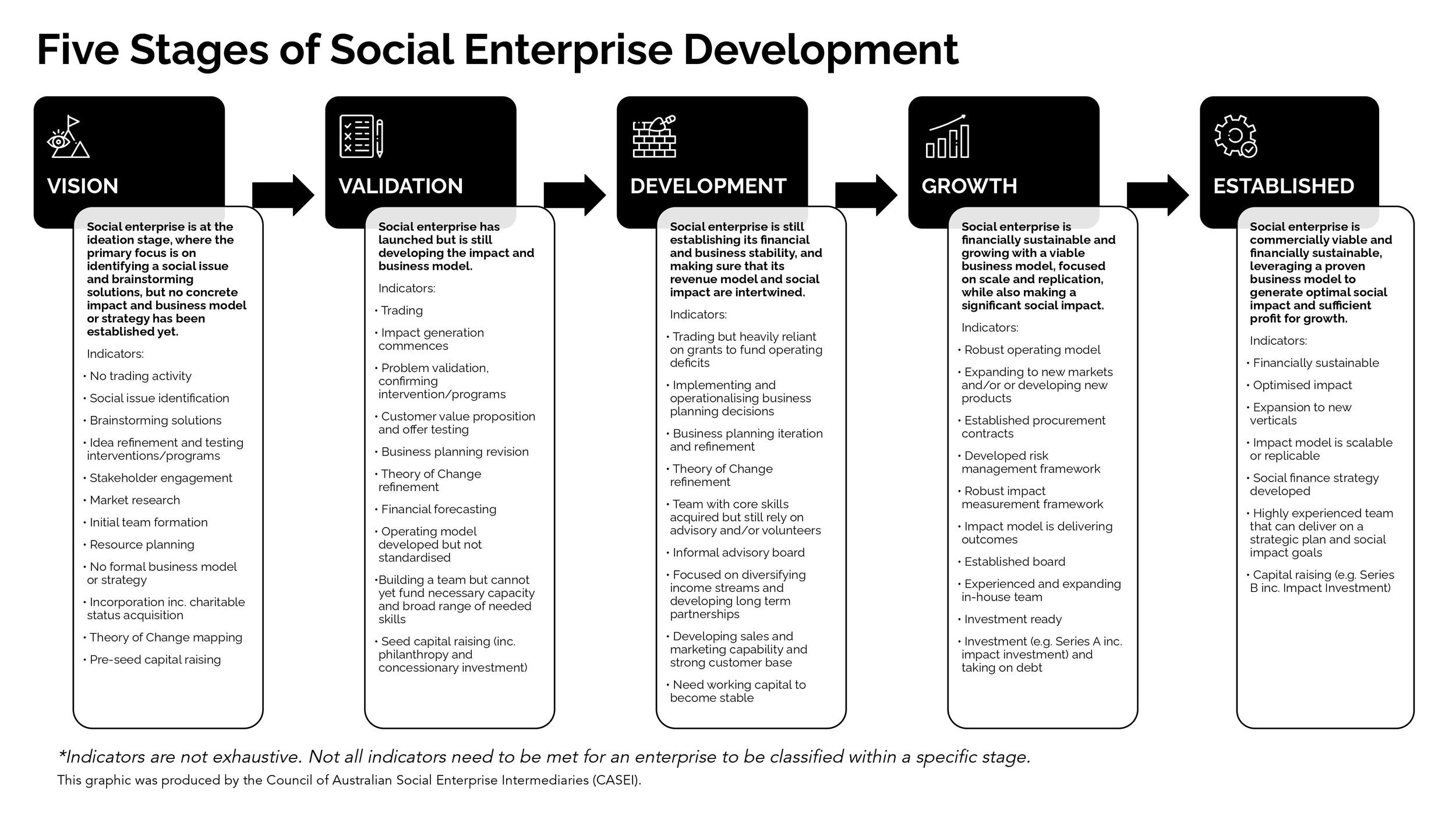
Five Stages of Social Enterprise Development
Understanding the journey of social enterprise development is essential for creating a unified approach to support these impactful ventures. A shared language that defines the distinct phases of growth helps intermediaries collaborate more effectively and tailor their support to meet the specific needs of social enterprises at each stage. This common terminology not only strengthens relationships between intermediaries, governments, and philanthropists but also empowers social entrepreneurs to assess their current stage of development and navigate the challenges that come with it.
Recognising this need, the Council of Australian Social Enterprise Intermediaries (CASEI) created an illustrative guide aptly titled Five Stages of Social Enterprise Development, building on the work of Sefa, The Centre for Social Impact Swinburne, Westpac Foundation, and Impact Seed.
Why the Five Stages of Social Enterprise Development?
This unified framework serves a dual purpose: it not only provides a common language for intermediaries, government bodies, and philanthropy organisations supporting social enterprises, but also acts as a roadmap for social enterprises themselves. It helps them understand their current position in their growth journey, enabling them to chart out their next steps more effectively.
Working Better Together
CASEI exists to help social enterprise intermediaries coordinate, share and align our work so the broader support ecosystem is more connected, navigable and effective.
Below are some examples that highlight how collaboration across organisations can reduce duplication, strengthen support pathways and create greater value for social enterprises.
NCEC Community Enterprises Cooperative (NCEC)
Growing Community Impact Through Connected Support and New Opportunities
Nundah Community Enterprises Cooperative (NCEC) is a member-owned Queensland social enterprise creating local jobs, delivering practical services and supporting community impact.
Over several years, NCEC has been supported by different intermediaries in different ways. Social Impact Hub worked with the cooperative over five years, supporting two strategic plans, a senior management review and Theory of Change work through its Professional Impact Network. CEO Richard Warner said this support helped NCEC achieve sustainable growth, with the cooperative almost doubling its turnover and impact, and helped it respond to the challenges of COVID and the period that followed.
Social Traders certified NCEC and helped it access new customer opportunities through buyer connections, curated lists, speaking opportunities and networking events. A Social Traders connection led to a three-year landscaping contract with Mirvac for Toombul Shopping Centre. StartSomeGood supported the launch of their “Good Food Trailer” through their Social Enterprise Design Challenge program and hosted their crowdfunding campaign. Impact Boom helped NCEC build visibility by including it in at least five Brisbane Social Enterprise Tours, involving more than 350 leaders, as well as panels, blog and podcast features.
NCEC’s growth shows how different intermediaries can play complementary roles in supporting social enterprise, from strategy and internal capability to customer access, visibility and storytelling.
Image credit: NCEC

Australian Spatial Analytics
From Incubation to Scale: Building the Foundations for Growth
Australian Spatial Analytics (ASA) is a Queensland-based social enterprise employing young neurodiverse adults as data analysts for government and corporate clients.
Its journey has been supported by several intermediaries, each playing a different role. White Box Enterprises founded and incubated ASA during its first three years, supporting governance, funding, CEO recruitment, accommodation, contract opportunities, mentoring, shared services and philanthropic connections.
Social Impact Hub supported ASA through a co-designed, multi-year advisory relationship across investment readiness, strategy, governance, pricing and impact measurement. Over three years, this included more than 100 hours of support through five expert consultants. Social Traders certified ASA, recommended it to corporate and government buyers, introduced ASA to Ventia, and supported the enterprise through two 12-month Grow Programs. Impact Boom helped build visibility through social enterprise tours, panel opportunities, and blog and podcast features.
ASA’s development shows how different kinds of intermediary support can work together, from incubation and governance through to investment readiness, customer access and storytelling.
Image credit: ASA

The Role of Philanthropy in Australia’s Social Enterprise Ecosystem
Shaping & Fuelling Change explores the role philanthropy has played in shaping Australia’s social enterprise ecosystem over the past 20–25 years, and what more thoughtful, sustained ecosystem funding could enable next.
The report was authored by May Miller-Dawkins, with contributions from Jessica Desmond, Courtney Collins and Alex Hannant. It was supported by Siddle Family Foundation, English Family Foundation, Westpac Foundation and Philanthropy Australia.
CASEI did not author the report, but we were pleased to contribute to the consultation process and to see CASEI’s role in the ecosystem recognised. The report strongly aligns with our work to help social enterprise intermediaries coordinate, share and align their efforts so the existing support ecosystem is more coherent, connected and effective.
For funders, intermediaries, policymakers and sector leaders, the report offers valuable insights into how social enterprise ecosystems develop, why infrastructure and coordination matter, and how capital can better support long-term, equitable systems change.